Yuya Nakazawa
1. Congratulations on winning the London Design Awards! Can you introduce yourself and share about what inspired you to pursue design as a career?
I am a Japanese furniture maker and designer, originally trained as a video editor. Although these fields appear different, I see both as ways of shaping human experience and emotion. Through working directly with materials and creating objects that people live with every day, I realised that design has a powerful, tangible impact on daily life. That realisation led me to pursue furniture design as a career.
2. What does being recognised in the London Design Awards mean to you?
Being recognised by the London Design Awards affirms that my work resonates within an international product design context. It is meaningful to have the balance between concept, form, and usability acknowledged, and it encourages me to continue developing my practice with confidence.
3. How has this achievement impacted your career, team, or agency, and what opportunities has it brought so far?
This achievement has increased the visibility of my work and created opportunities to connect with collectors and design professionals. It has also clarified my direction as an independent maker, helping me take concrete steps toward establishing a sustainable production environment.
4. What role does experimentation play in your creative process? Can you share an example?
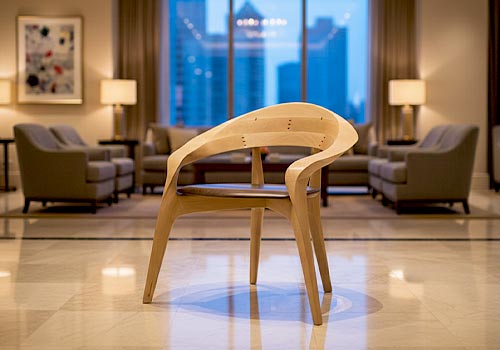
Experimentation is central to my process. The ORUHA Chair could not be fully resolved through drawings alone. I worked through clay models and repeated prototypes, shaping the final form directly by hand. Design and fabrication progressed simultaneously, allowing the material itself to guide decisions.
5. What's the most unusual source of inspiration you've ever drawn from for a project?
My background is in video editing. Editing teaches how structure and context alter emotional perception. I apply the same thinking to furniture, where subtle changes in curve or proportion can dramatically affect how a piece feels when used.
6. What’s one thing you wish more people understood about the design process?
That good design is rarely quick or effortless. It is built through repetition, failure, and refinement. Uncertainty is not a weakness in the process—it is often where meaningful decisions emerge.
7. How do you navigate the balance between meeting client expectations and staying true to your ideas?
I focus on clarity of intent. I am open to adjustment, but if a compromise undermines the core concept of a piece, I choose not to proceed. I believe honest boundaries lead to stronger outcomes for both designer and client.
8. What were the challenges you faced while working on your award-winning design, and how did you overcome them?
The main challenge was translating an organic, asymmetrical form into wood without clear reference points. Measurement alone was insufficient, so I relied on experience and intuition. Accepting imperfection as part of the process was essential to completing the work.
9. How do you recharge your creativity when you hit a creative block?
I step away from making it entirely. Spending time with family or walking without a goal helps reset my perspective and allows ideas to return naturally.
10. What personal values or experiences do you infuse into your designs?
I value honesty, care, and the passage of time. I design objects to be used, to age, and to change with their owners. Furniture should accompany life, not remain static or untouchable.
11. What is an advice that you would you give to aspiring designers aiming for success?
Do not rush to be understood. Focus on building depth through practice and failure. Over time, your work will begin to speak clearly on its own.
12. If you could collaborate with any designer, past or present, who would it be and why?
George Nakashima. His deep respect for material and his philosophy of revealing the life within wood strongly align with my own approach to craft and design.
13. What's one question you wish people would ask you about your work, and what's your answer?
Question: “How do your designs change over time?”
Answer: They evolve through use, repair, and ageing. That transformation is not a flaw—it is the completion of the design.