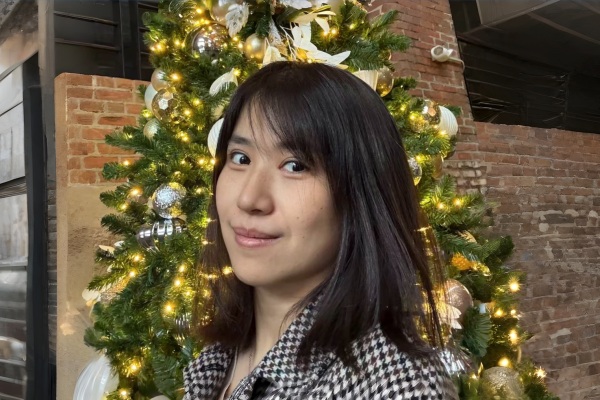
Lingyi Meng
1. Congratulations on winning the London Design Awards! Can you introduce yourself and share about what inspired you to pursue design as a career?
My name is Lingyi Meng. I come from a technology, data science, and software engineering background, with graduate degrees in Information Systems from George Washington University and Data Science from the University of Pittsburgh. My career has included work as a Data Scientist in engineering, a Machine Learning Engineer at a consulting company, a Business Intelligence Engineer in the nonprofit sector, and now a Software Engineer in long-term care technology.
I would not describe myself as a traditional professional designer. Instead, I am someone with a strong passion for concept design and innovation—especially using Artificial Intelligence and Machine Learning to solve real-life problems. What inspired me was realising that advanced technology only creates value when it is translated into practical, human-centred solutions. Design, to me, is the process of turning AI ideas into products that can improve accessibility, healthcare, efficiency, and everyday life.
2. What does being recognised in the London Design Awards mean to you?
Being recognised in the London Design Awards is both an honour and a meaningful milestone for me. As someone whose background is rooted in AI, machine learning, and engineering rather than traditional design, this recognition shows that innovation can come from interdisciplinary thinking and a genuine desire to solve real-world problems.
It validates my belief that design is not limited to aesthetics—it is also about transforming advanced technology into practical, human-centred solutions that improve everyday life. More personally, it motivates me to continue exploring how AI and concept design can create positive social impact, especially in areas such as accessibility, healthcare, and inclusion.
3. How has this achievement impacted your career, team, or agency, and what opportunities has it brought so far?
This achievement has had a meaningful impact on my career by giving greater visibility and credibility to my work at the intersection of AI, technology, and concept design. It reinforced my confidence to continue pursuing ideas that combine innovation with real-world purpose, even when they come from outside traditional design paths.
Professionally, it has opened new conversations with collaborators, industry peers, and organisations interested in accessibility, healthcare technology, and AI-driven products. It has also created opportunities to share my perspective on how machine learning and thoughtful design can work together to solve everyday challenges.
Most importantly, this recognition has encouraged me to think bigger—not only about building products, but about creating solutions that can generate lasting social impact and improve the quality of life for underserved communities.
4. What role does experimentation play in your creative process? Can you share an example?
Experimentation plays a central role in my creative process because innovation rarely comes from following a fixed formula. Working in AI and emerging technologies has taught me that the best ideas often come through testing possibilities, learning from failure, and continuously refining concepts. Experimentation allows me to challenge conventional thinking and discover solutions that may not be obvious at the start.
For example, in this concept project focused on supporting visually impaired users, I explored combining wearable computer vision, environmental sensors, and AI voice guidance into a single mobility assistance system. Instead of relying on one device or one technology, I experimented with how multiple intelligent systems could work together to create a safer and more intuitive user experience.
That process showed me that creativity is not only about imagination—it is also about iteration, problem-solving, and being willing to test new ideas until they become practical and meaningful.
5. What's the most unusual source of inspiration you've ever drawn from for a project?
One of the most unusual sources of inspiration for me has been traffic systems and city infrastructure. Most people see intersections, pedestrian signals, and transportation networks as purely functional parts of daily life, but I see them as highly coordinated systems designed to guide movement, reduce risk, and create order in complex environments.
That perspective inspired me to think about how similar principles could be applied to human-centred technology. For example, I explored how AI-powered navigation tools could help visually impaired users move through busy urban spaces with greater confidence and independence. In that sense, something as ordinary as a traffic signal became an inspiration for designing smarter accessibility solutions.
It reminded me that creativity often comes from places people overlook. Sometimes the most innovative ideas are hidden inside everyday systems we interact with but rarely stop to study.
6. What’s one thing you wish more people understood about the design process?
One thing I wish more people understood is that design is far more than making something look attractive. At its core, design is a problem-solving process that requires research, empathy, strategy, testing, and continuous refinement. The visual result is only the final layer of much deeper thinking.
Good design begins with understanding people—their needs, frustrations, behaviours, and goals. It then requires balancing creativity with practicality, innovation with usability, and vision with real-world constraints. Whether designing a product, system, or experience, every decision should serve a purpose.
I also believe great design often looks simple because of the complexity that has already been solved behind the scenes. What appears effortless to the user is usually the result of many iterations, difficult choices, and careful attention to detail.
7. How do you navigate the balance between meeting client expectations and staying true to your ideas?
I believe the best outcomes happen when collaboration is built on a shared understanding of the real goal. Rather than seeing client expectations and creative ideas as competing forces, I try to align both around the problem we are solving and the value we want to create.
My first step is always to listen carefully and understand the client’s objectives, priorities, and concerns. Once that foundation is clear, I can bring forward ideas that not only meet expectations but also introduce innovation, efficiency, or a stronger user experience. In many cases, clients are not simply looking for a specific design—they are looking for results.
Staying true to my ideas means protecting the principles I value most: functionality, clarity, human-centred thinking, and long-term impact. At the same time, I remain flexible in how those ideas are executed. I have found that the strongest solutions come from balancing vision with practicality and creativity with trust.
8. What were the challenges you faced while working on your award-winning design, and how did you overcome them?
One of the biggest challenges was transforming a complex AI-driven concept into something clear, practical, and human-centred. Advanced technologies such as machine learning, sensor systems, and intelligent automation can be powerful, but if they feel confusing or intimidating, they lose their real value to users.
Another challenge was balancing innovation with feasibility. It is easy to imagine bold ideas, but meaningful design requires thinking about how those ideas could realistically function in everyday life, especially for people who rely on accessibility and safety. I needed to ensure that the concept was not only visionary but also intuitive and relevant.
I overcame these challenges by focusing on the user experience first. Instead of starting with the technology itself, I asked how the solution could create confidence, independence, and simplicity for the people using it. That mindset helped guide every design decision and turn technical complexity into a more approachable and purposeful experience.
Ultimately, I learned that successful innovation is not about showing how advanced the technology is—it is about making that technology feel natural, useful, and empowering.
9. How do you recharge your creativity when you hit a creative block?
When I hit a creative block, I usually step away from the screen and reconnect with the real world. Some of the best ideas come when I stop forcing the process and start observing everyday life—how people move, communicate, solve problems, and adapt to their environments. Real human behaviour often provides more inspiration than endless brainstorming.
I also like to change my environment by taking a walk, visiting a new place, or spending time in public spaces where I can observe systems in motion. Cities, transportation networks, healthcare settings, and simple daily interactions often spark new perspectives for me.
Another way I recharge creativity is by exploring fields outside my own, such as architecture, psychology, science, or nature. Innovation often happens when ideas from different disciplines connect in unexpected ways.
Most importantly, I’ve learned that creative blocks are not failures—they are usually signals to pause, reset, and allow new ideas room to emerge naturally.
10. What personal values or experiences do you infuse into your designs?
I try to bring empathy, practicality, and inclusiveness into everything I design. My background across data science, machine learning, consulting, and software engineering has shown me that technology is most valuable when it genuinely improves people’s lives. That belief strongly shapes the way I approach ideas and problem-solving.
I am also influenced by my experience working in sectors such as engineering, nonprofit organisations, and long-term care technology. These environments taught me that every system ultimately affects real people, often in ways that are not immediately visible. Because of that, I always think about accessibility, dignity, and ease of use—especially for individuals whose needs are often overlooked.
Another value I bring is continuous learning. Working across multiple disciplines has taught me to stay curious, adaptable, and open to new perspectives. I believe the strongest designs are created when innovation is guided not only by intelligence, but also by compassion and responsibility.
Ultimately, I want my work to reflect a simple principle: technology should empower people, not complicate their lives.
11. What is an advice that you would you give to aspiring designers aiming for success?
My advice would be to focus on solving real problems rather than simply chasing trends or recognition. Great design is not only about creating something visually impressive—it is about creating something meaningful, useful, and valuable to people. When you prioritise impact, success tends to follow naturally.
I would also encourage aspiring designers not to limit themselves to one discipline. The future belongs to people who can combine design with technology, psychology, business, and human understanding. The more perspectives you learn from, the more original and effective your ideas will become.
Be patient with the process as well. Strong work rarely happens overnight. It comes through experimentation, failure, revision, and persistence. Every challenge you face helps you develop your creative judgment and resilience.
Finally, stay curious and stay authentic. Trends will change, tools will evolve, and industries will shift, but originality, empathy, and a genuine desire to improve the world will always remain valuable.
12. If you could collaborate with any designer, past or present, who would it be and why?
If I could collaborate with any designer, it would be Dieter Rams. I deeply admire his philosophy that good design should be innovative, useful, understandable, and as simple as possible. His work demonstrates that true design excellence is not about excess—it is about clarity, purpose, and timeless value.
As someone who works at the intersection of AI, technology, and concept innovation, I find his principles especially relevant today. We live in an age where products are becoming increasingly complex, yet users still need experiences that feel natural, intuitive, and human-centred. Dieter Rams understood how to remove unnecessary complexity while preserving functionality, which is a lesson that modern technology designers can still learn from.
I believe collaborating with him would be inspiring because it would combine two worlds: his timeless minimalist design philosophy and my interest in applying emerging technologies such as AI and machine learning to solve real-life challenges. Together, the goal would be to create products that are both intelligent and elegantly simple.
13. What's one question you wish people would ask you about your work, and what's your answer?
One question I wish people would ask me is: “How can your work make life better for others?”
My answer would be that this is the question that matters most to me. While technology can be impressive, its true value lies in how it improves human life. I am most inspired by ideas that can create greater independence, dignity, safety, and opportunity for people—especially those whose challenges are often overlooked.
Whether through AI-powered accessibility tools, smarter healthcare solutions, or systems that simplify everyday experiences, my goal is to use innovation in a meaningful way. I do not see design and technology as ends in themselves but as tools to solve real problems and create positive social impact.
If my work can help even one person feel more empowered, more included, or more confident in their daily life, then I would consider that a success.