Zhang Jingyue
1. Congratulations on winning the London Design Awards! Can you introduce yourself and share about what inspired you to pursue design as a career?
I am Zhang Jingyue, a designer focusing on inclusive and healthcare-oriented product design. I am deeply motivated by real social demands and vulnerable groups’ daily needs. Design is not merely creating beautiful appearances, but a powerful way to solve practical problems and bring warmth and dignity to people’s lives. This heartfelt wish drives me to stick to design as my lifelong career.
2. What does being recognised in the London Design Awards mean to you?
Winning recognition from the London Design Awards is a great affirmation of my human-centred design concept. It proves that caring design for the disabled and elderly groups is valuable and worthy of being seen globally.
Meanwhile, this honour also encourages me to keep exploring accessible design and makes me more determined to create practical and considerate works for people in need.
3. How has this achievement impacted your career, team, or agency, and what opportunities has it brought so far?
This award greatly enhances my professional credibility and industry influence. It brings more exposure and cooperation opportunities in healthcare assistive design. I gain more chances to communicate with overseas designers and research institutions. It also lets more people notice the neglected demands of hemiplegia rehabilitation, laying a solid foundation for my future career focusing on medical and inclusive design.
4. What role does experimentation play in your creative process? Can you share an example?
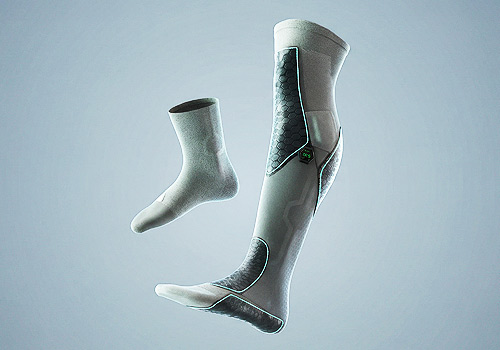
Experiment is the core part of my creation. It helps me verify functions, adjust details and turn abstract ideas into feasible products. For this thermostatic socks design, I repeatedly tested temperature control sensitivity, fabric comfort and wearing experience for hemiplegic patients. Multiple experiments helped me optimise the wearing structure and constant temperature system to fit the physical characteristics of disabled users.
5. What's the most unusual source of inspiration you've ever drawn from for a project?
The most special inspiration comes from the real life of hemiplegic patients. I observed their difficulties in keeping limbs warm and the inconvenient daily nursing. Their hidden pain and unmet rehabilitation demands touched me deeply. I hope to use design to relieve their physical discomfort and ease the burden of family caregivers, which became the original inspiration of this thermostatic rehabilitation socks.
6. What’s one thing you wish more people understood about the design process?
I hope people can understand that design starts from real needs rather than blind aesthetics. Every size, function and material choice is based on users’ actual experience. Especially for healthcare design, the whole process revolves around solving pain points. Good design hides meticulous care behind a simple appearance and serves people sincerely.
7. How do you navigate the balance between meeting client expectations and staying true to your ideas?
I take user demands as the core balance standard. I fully listen to practical requirements and accept reasonable suggestions to meet basic expectations. When my original design concept conforms to users’ long-term interests and health safety, I will stick to it patiently. I communicate sufficiently to explain design logic and seek common ground while reserving differences to reach a balanced, optimal solution.
8. What were the challenges you faced while working on your award-winning design, and how did you overcome them?
The biggest challenges lay in functional balance and ergonomic adaptation. It was hard to match stable constant temperature effect with soft wearable fabric, and the wearing structure needed to suit patients with limited limb mobility. I solved these difficulties by consulting medical rehabilitation professionals, simulating wearing tests continuously, adjusting material proportion and structural radian step by step to perfect the final work.
9. How do you recharge your creativity when you hit a creative block?
I recharge creativity by observing real life and communicating with target users. Staying away from rigid design thinking, I visit rehabilitation institutions and listen to users’ feelings. Nature and daily trivialities also bring new inspiration. Proper rest and cross-field design viewing can break mental barriers and bring fresh, creative ideas.
10. What personal values or experiences do you infuse into your designs?
I integrate kindness, inclusiveness and respect for every life into my design. I witnessed the inconvenience brought by physical disabilities, so I always put vulnerable groups in the first place. I hope my design can eliminate discrimination, bring comfort and equal care, and use gentle design power to warm special groups’ daily lives.
11. What is an advice that you would you give to aspiring designers aiming for success?
I suggest young designers keep rooted in real life and care about the people around them. Do not pursue fancy design blindly, and firmly hold your original aspiration. Keep persistent learning and bold trial. Treat every work with sincerity, take user experience seriously, and let design truly solve problems and deliver warmth.
12. If you could collaborate with any designer, past or present, who would it be and why?
I would choose designers who devote themselves to barrier-free and medical care design. They always regard human needs as a priority, and create down-to-earth works full of humanity. I hope to cooperate with them to exchange practical design experience, jointly polish more inclusive assistive products, and benefit more people in need.
13. What's one question you wish people would ask you about your work, and what's your answer?
I hope my design can arouse public attention to the rehabilitation of the disabled and the elderly. I expect more warm, inclusive designs to emerge, reduce life barriers for vulnerable groups, and let design become a reliable backing to protect everyone’s healthy and dignified life.