Zhenhua Chen
1. Congratulations on winning the London Design Awards! Can you introduce yourself and share about what inspired you to pursue design as a career?
My name is Zhenhua Chen. I am an industrial designer and CAD engineer and the founder of Built by Zhen, an independent design practice focused on calm physical objects, structural clarity, and everyday rituals.
I was drawn to design because it sits between observation and making. I have always been interested in how small objects shape the way people move, pause, organise, and transition through daily life. Industrial design gave me a way to turn those observations into physical systems — objects that are not only visually resolved, but also structurally understandable and emotionally quiet.
For me, design is not only about creating something new. It is also about noticing what is already happening in ordinary environments and giving it a clearer form.
2. What does being recognised in the London Design Awards mean to you?
Being recognised by the London Design Awards is very meaningful because ENTRY is an independent project developed under Built by Zhen. It began with a quiet observation of the home entrance, a space that is often overlooked but full of small frictions.
Receiving a Silver award gives the project external validation and encourages me to continue developing Built by Zhen as a design practice. It also means that the values behind the work — calmness, clarity, structure, and attention to everyday transitions — can be understood beyond my own studio context.
For an early independent practice, this recognition is not only an award. It is also a signal that a quiet, detail-driven approach to product design can still communicate strongly.
3. How has this achievement impacted your career, team, or agency, and what opportunities has it brought so far?
The achievement has helped strengthen the foundation of Built by Zhen. As an independent design practice, credibility is built step by step, and this recognition gives ENTRY a clearer place within my portfolio and public work.
It has also encouraged me to communicate the project more confidently through my website, professional profile, and future project presentations. The award helps position Built by Zhen not only as a collection of concepts, but as a practice with a consistent point of view: designing quiet tools for everyday life.
It is still early, but the recognition has already given me more confidence to continue developing independent projects, sharing them publicly, and connecting with people who care about thoughtful product design.
4. What role does experimentation play in your creative process? Can you share an example?
Experimentation is central to my process, but I usually approach it through structure rather than pure visual exploration. I like to test how a product behaves as a system: how it stands, how it holds objects, how water moves, how surfaces meet, and how users understand its logic without explanation.
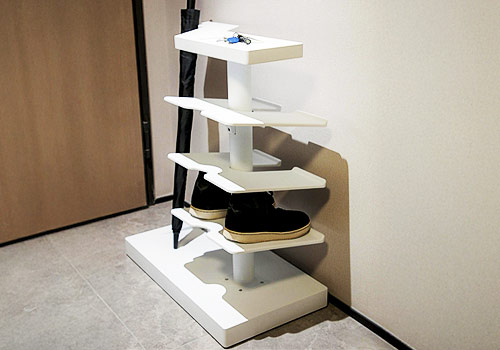
In ENTRY, experimentation happened through the relationship between vertical storage, drainage, and the entryway ritual. I explored how one compact object could support umbrellas, shoes, keys, bags, and wet-dry transitions without becoming visually noisy.
The challenge was to make the object feel calm while still doing several things. That required many small decisions about proportion, rhythm, grounding, surface hierarchy, and how each function could be visually integrated rather than added on.
5. What's the most unusual source of inspiration you've ever drawn from for a project?
For ENTRY, one of the main inspirations was the uncomfortable moment of coming home on a rainy day. A wet umbrella, damp shoes, keys, bags, and a narrow entryway can create a small but recurring domestic disorder.
That moment may seem ordinary, but I found it very interesting as a design problem. The home entrance is not just a storage area. It is a threshold between outside and inside, wet and dry, public and private, movement and rest.
Instead of looking at furniture typologies first, I looked at that transition itself. The unusual inspiration was not a beautiful object, but a messy daily moment that many people experience and quickly forget.
6. What’s one thing you wish more people understood about the design process?
I wish more people understood that design is often less about sudden inspiration and more about careful reduction. A product may look simple at the end, but that simplicity usually comes from many decisions being tested, removed, adjusted, or clarified.
In my process, a quiet object is not an empty object. It still needs structure, use logic, proportion, material presence, and emotional restraint. The work is in making these elements feel natural together.
Good design often disappears into daily life, but that does not mean it was easy to create. The clearer an object feels, the more carefully its relationships usually had to be resolved.
7. How do you navigate the balance between meeting client expectations and staying true to your ideas?
I try to treat constraints as part of the design language rather than as limitations outside the project. Even in independent work, there are always client-like expectations: the needs of users, the realities of manufacturing, the clarity of communication, and the emotional tone of the object.
For me, staying true to an idea does not mean protecting the first concept. It means protecting the core intention. In ENTRY, the core intention was to treat the entrance as a wet-dry threshold and to create a calm vertical system around that idea.
Details can change, proportions can improve, and functions can be reorganised. But the central logic of the project should remain clear. That balance between flexibility and conviction is important to me.
8. What were the challenges you faced while working on your award-winning design, and how did you overcome them?
The main challenge was avoiding visual clutter. ENTRY needed to address several functions — umbrella placement, water collection, shoes, keys, bags, and the general arrival ritual — but I did not want it to become a busy storage product.
I overcame this by focusing on vertical organisation and structural hierarchy. Instead of treating every function as a separate attachment, I worked to make the object read as one continuous domestic form. The base, trays, vertical body, and object placements were developed as part of the same rhythm.
Another challenge was communicating the wet-dry concept clearly through images. The project needed to show both function and atmosphere, so the final presentation combined lifestyle context, form details, and close-up views of the product logic.
9. How do you recharge your creativity when you hit a creative block?
When I hit a creative block, I usually step away from trying to make the project look better and return to the behaviour behind it. I ask what the user is doing, what the object is trying to support, and where the friction actually comes from.
I also find it helpful to move between digital and physical thinking. Sometimes I work through CAD details, proportions, or assembly logic. Other times I simply observe daily spaces, sketch small relationships, or look at how ordinary objects are placed in real environments.
For me, creativity often returns when the problem becomes specific again. Once I understand the behaviour more clearly, the form usually has a reason to continue.
10. What personal values or experiences do you infuse into your designs?
I value calmness, clarity, and responsibility toward everyday life. I am interested in objects that do not demand too much attention, but still improve the way people live with them.
My background as both an industrial designer and CAD engineer also shapes my work. I care about how something looks, but I also care about how it is structured, how it might be built, and whether its logic is understandable. I like objects that feel quiet but not vague.
Many of my projects come from overlooked moments: arriving home, pausing in a public space, storing everyday things, or creating small transitions between activities. I try to give those moments a more thoughtful physical form.
11. What is an advice that you would you give to aspiring designers aiming for success?
I would advise aspiring designers to build both sensitivity and discipline. Sensitivity helps you notice problems that others overlook. Discipline helps you turn those observations into something clear, resolved, and communicable.
It is also important to learn how to explain your work without over-explaining it. A strong project should have a clear visual and functional logic, but the story behind it should also help people understand why it matters.
Awards, recognition, and opportunities are valuable, but they should come from sustained work. Keep making, keep refining, and pay attention to the small decisions. Very often, the quality of a design is found in the details that no one notices at first.
12. If you could collaborate with any designer, past or present, who would it be and why?
I would choose Naoto Fukasawa. His work has a deep sensitivity to unconscious behaviour, everyday gestures, and the quiet relationship between people and objects.
I admire how his designs often feel simple without becoming empty. They seem to understand how people naturally live, move, and interact with things. That kind of restraint is difficult to achieve because it requires both empathy and precision.
A collaboration with him would be meaningful because my own interests also focus on ordinary rituals, calm presence, and objects that fit into daily life without creating unnecessary noise.
13. What's one question you wish people would ask you about your work, and what's your answer?
I wish people would ask: “Why focus on such ordinary moments?”
My answer is that ordinary moments are where design has the most consistent influence. Most people do not interact with dramatic objects every day, but they do come home, put things down, organise small belongings, move through thresholds, and look for moments of calm.
ENTRY was designed around one of those moments. It does not try to make the home entrance spectacular. Instead, it tries to make it clearer, calmer, and more intentional.
I believe design can be meaningful without being loud. Sometimes the most valuable object is the one that quietly improves a repeated daily ritual.