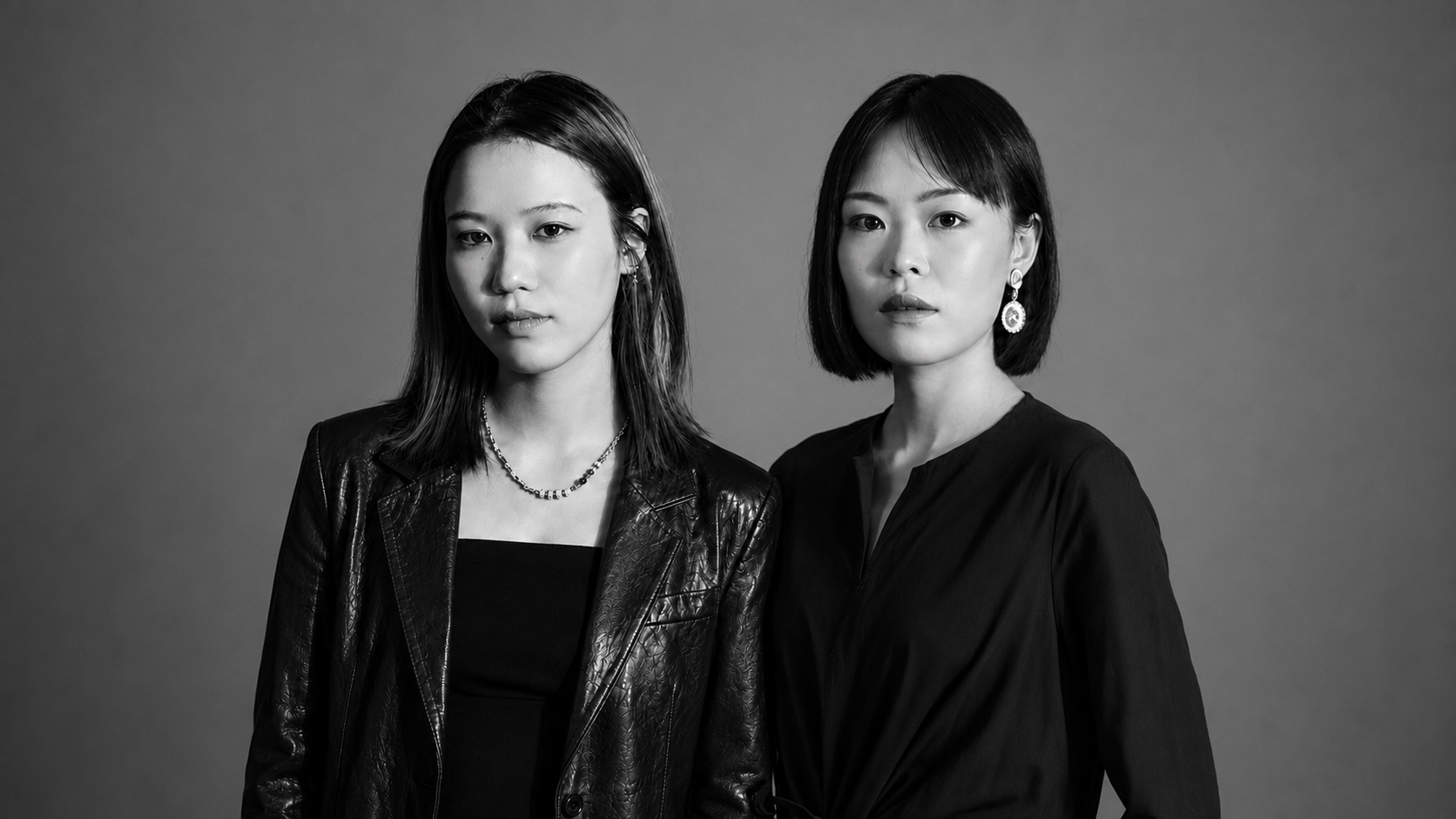
Yingxiao Chen & Tian Zhou
1. Congratulations on winning the London Design Awards! Can you introduce yourself and share about what inspired you to pursue design as a career?
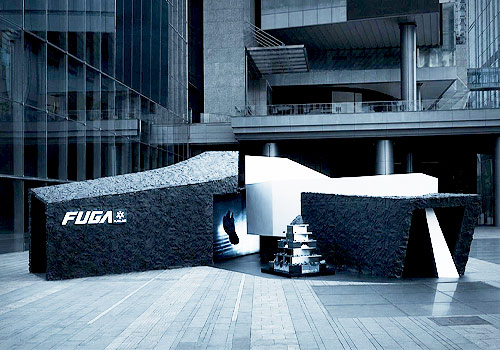
Faultline Pavilion is a collaborative project developed through our shared interest in architecture, art, and spatial experimentation.
Our practices come from different but complementary backgrounds. Yingxiao Chen's work spans architecture, exhibitions, installations, and spatial research, exploring new relationships between form, materiality, experience, and space. While Tian Zhou works across moving image, scenography, and spatial practice, focusing on narrative construction and visual storytelling through research-driven approaches.
Together, we investigate the possibilities that emerge between disciplines, creating experimental spatial works that challenge conventional ways of experiencing architecture. Our collaboration is rooted in an ongoing dialogue, where different perspectives and creative methodologies come together to shape new spatial experiences.
2. What does being recognised in the London Design Awards mean to you?
Yingxiao Chen: Receiving this award means a great deal to me. Architecture has always been the career I wanted to dedicate my life to, and this recognition gives me confidence to continue pursuing that path.
Tian Zhou: This award encourages me to continue experimenting through design. I believe commercial spaces can be more than places for brand presentation, serving instead as sites for spatial storytelling. This recognition gives me confidence to keep exploring that direction.
3. How has this achievement impacted your career, team, or agency, and what opportunities has it brought so far?
This recognition has increased our international visibility and strengthened our confidence in our cross-disciplinary approach. It also opens up new opportunities to share our work with a broader international audience and contribute to ongoing conversations about architecture and art.
4. What role does experimentation play in your creative process? Can you share an example?
Experimentation is at the core of our practice. Rather than treating architecture as the production of form, we see it as a way to explore how space can shape perception and experience. In Faultline Pavilion, we translated the embodied experience of trail running into a spatial narrative, allowing the products to be integrated into the journey rather than simply presented as objects on display.
5. What's the most unusual source of inspiration you've ever drawn from for a project?
Our inspiration often comes from beyond architecture. In Faultline Pavilion, we draw inspiration from cinematic storytelling. By borrowing ideas from cinematography, scenography, and editing, we choreograph space as a sequence of unfolding scenes rather than a static environment. In this pavilion, visitors enter through a narrow passage between rock-like forms and gradually encounter shifting light, texture, and spatial rhythm before emerging into an illuminated finale, unfolding like an adventure through space.
6. What’s one thing you wish more people understood about the design process?
Tian Zhou: I believe good design begins beyond the object itself. I focus on understanding the scenarios, emotions, and experiences behind a product, then translating these elements into a spatial narrative. For me, design is about creating connections between people, objects, and environments rather than simply presenting products.
Yingxiao Chen: Many people think design begins with a good idea, but the true challenge lies in transforming that idea into a coherent spatial language. From materiality, light, circulation, details and construction, every decision plays a role in translating abstract intentions into an embodied experience. Every layer of design contributes to how a space is perceived, experienced, and ultimately understood.
7. How do you navigate the balance between meeting client expectations and staying true to your ideas?
Our practice spans multiple scales and disciplines, while exhibition design is especially rewarding because it brings us into dialogue with experts from different fields. Every collaboration is an opportunity to learn, and we believe the best projects emerge through mutual discovery and co-creation. Rather than simply responding to a client's brief, we seek to understand the intention behind each commission and translate it into a coherent spatial system.
8. What were the challenges you faced while working on your award-winning design, and how did you overcome them?
In this project, we sought to challenge the conventional image-driven approach often found in commercial spaces. Instead of treating the space as a visual container for products, we approached design through the translation of embodied experience, exploring how products could be embedded within a continuous spatial sequence while preserving an immersive journey.
As a temporary structure, the project was developed under constraints of budget, materials, scale, and construction time. These challenges required a constant negotiation between conceptual ambition and practical realities. Nevertheless, the project's fundamental spatial narrative remained unchanged throughout the design process.
9. How do you recharge your creativity when you hit a creative block?
Yingxiao Chen: I usually step away from architecture for a while. Drawing, knitting, and making things by hand help me slow down and reconnect with the joy of creating. These quiet moments often lead to unexpected ideas that eventually find their way back into my design work.
Tian Zhou: I keep my creative perspective active through continuous visual observation and image reading. I would go out for street photography, observing how everyday objects, arrangements, and environments reveal deeper cultural structures and social relationships. I also watch films to study how space is used as a narrative symbol in audiovisual storytelling, and how atmosphere, composition, and movement shape perception.
10. What personal values or experiences do you infuse into your designs?
Yingxiao Chen: Modernism produced a standardised spatial order governed by efficiency, predictability, and functional optimisation. In doing so, it gradually diminished the body's capacity to perceive space. My work challenges these inherited conventions by investigating alternative systems of spatial generation. Architecture is understood not as a neutral container for use, but as a medium capable of reconstructing perception.
Tian Zhou: I studied curatorial methods during my university years and have also collaborated on short film productions, which have shaped my understanding of the director’s mindset as a way of approaching creative practice. It influences my work in two ways: constructing narratives through research and interpretation, and maintaining an overall vision throughout the design process, from concept to execution.
11. What is an advice that you would you give to aspiring designers aiming for success?
Remain open and curious. Do not confine yourself to a particular style, medium, or methodology. Design is constantly evolving, and ideas often emerge from unexpected fields beyond architecture and design. Follow your passion, keep exploring, and allow your practice to evolve through continuous discovery.
12. If you could collaborate with any designer, past or present, who would it be and why?
Yingxiao Chen: I would choose Richard Serra. Experiencing his large-scale sculptures completely changed the way I understood space. Walking through his work, I felt physically disoriented and emotionally affected. It was the first time I realised that space could shape the body and perception as powerfully as any object.
Tian Zhou: I would love to collaborate with Patrice Vermette. What I admire most about his work is his ability to build immersive narrative worlds through spatial language. His approach reminds me that design is not only about creating forms but about understanding the cultural, environmental, and emotional systems behind them. This way of thinking strongly resonates with my own approach to spatial storytelling.
13. What's one question you wish people would ask you about your work, and what's your answer?
We wish people would ask: “How does your interdisciplinary approach inform this project, and how do you collaborate as a team?”
Our interdisciplinary approach is rooted in the dialogue between different ways of perceiving and constructing space. Yingxiao Chen brings a background in architecture, while Tian Zhou contributes her experience in film as a director and production designer. In this project, Tian Zhou approached space from a director’s perspective, translating experiential moments into a sequence of scenes where atmosphere, lighting, and rhythm were carefully choreographed.
Yingxiao Chen transformed this narrative logic into architectural form, using the intersection, suspension, and fragmentation of volumes to create diverse spatial conditions and bodily experiences. Through the dialogue between architecture and cinema, narrative and space continuously inform one another. The project emerged from the dialogue between architecture and cinema, where neither discipline served the other, but together generated a new spatial language.