Zhang Hengyan
1. Congratulations on winning the London Design Awards! Can you introduce yourself and share about what inspired you to pursue design as a career?
Thank you. My name is Zhang Hengyan. I'm an architect from China. I used to work at CADG and CPG in the past. Now I'm the lead architect of a design team at CADG. My team has been working on architectural and urban design for more than 10 years. In recent years, we have gradually focused on architectural complex design at the block scale, hoping that our works could reflect the unique local culture, environment and community needs.
I grew up in the west of China. The unique regional culture and profound traditional cultural heritage of my hometown planted the seeds of perception of space and art in my heart. Meanwhile, the rapid economic and technological development of China showed me the unlimited possibilities of everything. These led me to develop a passion for "creating things" and encouraged me to embark on the path of design.
2. What does being recognised in the London Design Awards mean to you?
Winning the London Design Awards is of great significance. It goes beyond the award itself. London is a city that combines a profound history with avant-garde innovation. Being recognised here means that our design concepts have an international resonance. This is also an encouragement, encouraging us to continue exploring the contemporary design language of the East within the context of globalisation.
3. How has this achievement impacted your career, team, or agency, and what opportunities has it brought so far?
The most significant impact is that it has brought about broader international attention and trust. Additionally, for the team, this has greatly boosted morale. Everyone is proud of this shared honour, which has consolidated our core design values. In the future, we hope that this award will provide us with the opportunity to showcase our thinking on a wider platform.
4. What role does experimentation play in your creative process? Can you share an example?
In my view, experimentation in architectural design should be progressive. As the oldest profession of mankind, architects' creations often have a long-lasting vitality, and every step of architectural development is built on a solid foundation of the past.
Therefore, in design, experimentation should not be simply regarded as the goal but as one of several methods to achieve the goal. Fully respecting the conditions of each project, each attempt should make some breakthroughs compared to the previous one, and eventually, unique innovations will accumulate.
5. What's the most unusual source of inspiration you've ever drawn from for a project?
Painting and sculpture are important sources of inspiration for me. For instance, Chinese jade carving can create a powerful visual impact with a small amount of jade material, making it look majestic, full and captivating. The essence of this lies in the principle of "treating jade as gold", which coincides with the classic architectural philosophy of "less is more".
6. What’s one thing you wish more people understood about the design process?
Many people who are not familiar with design often confuse "design" with "ideas", thinking that design is all about finding inspiration. In reality, design usually starts with a vague idea, and through research, dialogue, experimentation, and countless iterations, it gradually becomes clear. Clients sometimes expect designers to present a "perfect solution" in their first proposal, but the best solutions often emerge from our joint, in-depth exploration.
7. How do you navigate the balance between meeting client expectations and staying true to your ideas?
This is extremely difficult and often unattainable in my work. However, I firmly believe that designers should help clients uncover their fundamental needs deep down and assist them in expressing their true thoughts. This can help eliminate differences between us and achieve our common goals together.
8. What were the challenges you faced while working on your award-winning design, and how did you overcome them?
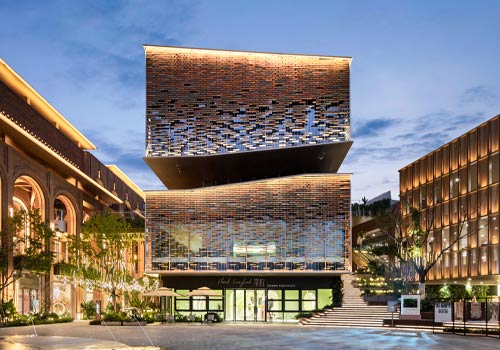
The biggest challenge was the tight schedule; from the start of the design to the completion of "Chongqing Hill", we only had 10 months. Additionally, the project's cost constraints were another difficulty. To overcome these challenges, we devoted a significant amount of time to innovative discussions and experiments with other professional designers, material suppliers, and construction teams.
We also moved the design site from the office to the construction site, conducting numerous on-site designs and adopting an all-process accompanying design approach until the construction was completed, marking the end of our design. Although there were still some regrets, we did our best to ensure the final effect of the project.
9. How do you recharge your creativity when you hit a creative block?
Reading or outdoor activities can be very helpful. It's not about letting the brain rest completely, but rather providing a different kind of sensory stimulation, which often leads to new ideas.
10. What personal values or experiences do you infuse into your designs?
I hope that in my designs, the concept of "symbiosis" can be reflected. "Symbiosis" is not merely about simply blending into the environment; rather, it involves integrating a "humble" attitude with an "innovative" mindset. This is also my understanding of the fusion of Eastern and Western philosophies.
11. What is an advice that you would you give to aspiring designers aiming for success?
First, you should be full of curiosity and hope for the world. Second, you should have at least one artistic hobby and stick to it for your entire life. Finally, you need to learn to understand and communicate.
12. If you could collaborate with any designer, past or present, who would it be and why?
I would choose Le Corbusier without hesitation. He is the true founder of modern architecture. No contemporary architect dares to claim that they have broken free from Le Corbusier’s influence.
Moreover, the fields he has been involved in and his influence have long exceeded the scope of architectural design. He is the true master at the top of the pyramid in human history. To have a dialogue with such a master would be an invaluable baptism for me.
13. What's one question you wish people would ask you about your work, and what's your answer?
What do you think is the core and most important aspect when designing a building?
My answer is: the attitude of the building's intervention in the environment.
I believe that the direction of architectural design is not fixed but closely related to the environment and the era in which it is situated. Under different conditions, buildings should present different attitudes and thus adopt different strategies. The most crucial thing is to first determine the spirit of the building, which can then guide subsequent aspects such as space, structure, and materials.
This is also my understanding of the concept of "Dao" in traditional Chinese culture as it applies to architectural design.