Yuehong Zhou
1. Congratulations on winning the London Design Awards! Can you introduce yourself and share about what inspired you to pursue design as a career?
Thank you. I'm Yuehong Zhou. I am a former Huawei UX Designer and the co-founder and UX designer of CarePath AI, focusing on AI healthcare UX, human-centred AI, and complex digital systems.
My background spans architecture, OS-level privacy interaction, smart cockpit HMI, and AI-assisted healthcare experiences. At Huawei, I worked on HarmonyOS NEXT privacy and security UX, intelligent mobility HMI, and XR interaction design. Those experiences taught me how to make complex digital systems feel clearer, safer, and more trustworthy.
CarePath AI was inspired by my experience accompanying elderly family members through hospital visits. I saw how stressful outpatient journeys can be for older patients, from check-in and payment to navigation, queue guidance, and understanding medical information. That made me wonder whether AI could become a gentle companion rather than a cold tool.
For me, design is about bringing clarity, dignity, and emotional support into complex systems, especially for people who are often overlooked by technology.
2. What does being recognised in the London Design Awards mean to you?
Being recognised in the London Design Awards means a lot to me. It confirms my belief that human-centred AI can create real value, especially for people who are often overlooked by technology.
As a former Huawei UX Designer, I worked on complex digital systems such as OS privacy experiences and smart cockpit HMI. CarePath AI feels like a more personal extension of that experience. It applies system-level design thinking to healthcare and elderly outpatient journeys.
This recognition encourages me to keep exploring AI healthcare UX, not only as a way to improve efficiency, but also as a way to bring more dignity, reassurance, and clarity to older adults facing complex medical systems.
3. How has this achievement impacted your career, team, or agency, and what opportunities has it brought so far?
This recognition has helped me define my next professional direction more clearly: working at the intersection of AI, healthcare UX and complex system design.
Professionally, it strengthened my transition from large-scale system experience design at Huawei, including OS privacy interaction and smart cockpit HMI, to more human-centred AI product development through CarePath AI. It has also given the project stronger credibility when speaking with people in healthcare, design, and AI-related fields.
For my team, the award validated our belief that elderly outpatient journeys deserve more thoughtful digital experiences. It encouraged us to continue exploring how AI can provide not only efficiency but also reassurance, dignity, and emotional support within healthcare systems.
4. What role does experimentation play in your creative process? Can you share an example?
Experimentation plays a central role in my creative process, especially when designing for complex systems and emotionally sensitive user journeys.
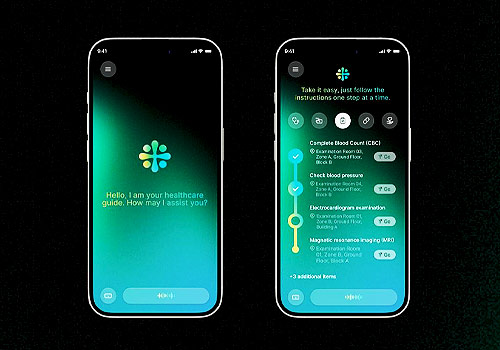
For CarePath AI, I explored different ways to guide elderly patients through outpatient tasks, including voice guidance, simplified visual flows, gentle vibration feedback, large buttons, and NFC-based interactions. One important experiment was reducing the need for typing or remembering information. Instead, users could simply tap a hospital card, phone, or wearable device to access appointment, navigation, and payment information.
Through early prototyping and feedback from older users and caregivers, I found that the combination of voice guidance, clear visual cues, gentle feedback, and NFC interaction was most effective in reducing confusion. That experiment directly shaped the final CarePath AI experience.
5. What's the most unusual source of inspiration you've ever drawn from for a project?
One unusual source of inspiration came from airport wayfinding systems. I was observing how elderly travellers moved through airports — especially how they relied on simple tap-and-follow behaviours at boarding gates and transportation checkpoints.
That experience later influenced CarePath AI. I realised that hospitals and airports actually share similar challenges: both are complex, high-stress environments where people can easily feel lost or anxious. This inspired me to introduce NFC-based interactions and step-by-step guidance for elderly outpatient journeys, reducing the need for typing, searching, or remembering complicated information.
6. What’s one thing you wish more people understood about the design process?
I wish more people understood that design is not just about making things look good. It is about solving real problems through testing, iteration, and listening carefully to users.
A final product may look simple, but behind that simplicity are many failed experiments, user feedback sessions, and difficult decisions. This is especially true when designing for elderly users, because every detail can affect whether they feel confused, anxious, or supported.
Good design takes time, patience, and a willingness to learn from mistakes. It is not created in one perfect moment, but shaped through many small improvements.
7. How do you navigate the balance between meeting client expectations and staying true to your ideas?
I usually start by understanding the goals, constraints, and concerns of different stakeholders. Then I explain my design decisions through user research, product logic, and testing insights.
When there is a conflict, I try to bring the discussion back to the user. For example, a team may want to add more features, but in an elderly healthcare journey, more features can easily create more confusion. In that situation, I would use research and prototypes to show why simplicity may better serve both the user and the product goal.
For me, staying true to my ideas does not mean insisting on a personal style. It means staying true to user needs, which usually supports the long-term success of the product as well.
8. What were the challenges you faced while working on your award-winning design, and how did you overcome them?
One of the biggest challenges was designing an AI healthcare experience for elderly users with very different levels of digital literacy. Some users are comfortable with smartphones, while others feel anxious even using basic hospital kiosks.
Another challenge was defining the role of AI carefully. I did not want CarePath AI to act as a diagnostic authority. Its role is to support the outpatient journey by explaining next steps, reducing uncertainty, and providing cognitive and emotional reassurance.
The outpatient system itself is also complex. Registration, navigation, payment, waiting queues, examination results, and medication instructions are connected, but often fragmented across different interfaces.
To address this, I applied the system-level thinking I developed while designing OS privacy flows and smart cockpit HMI at Huawei. I simplified the journey into step-by-step guidance, reduced unnecessary interruptions, and introduced NFC-based flows to minimise typing and memory burden.
Most importantly, I spent time observing elderly patients in real hospital environments. That helped me understand not only functional problems, but also anxiety and cognitive pressure. CarePath AI was ultimately designed not just to improve efficiency, but to make the healthcare journey calmer, clearer, and more humane.
9. How do you recharge your creativity when you hit a creative block?
When I hit a creative block, I usually step away from the screen and observe real environments and human behaviour. I often visit places like hospitals, transportation hubs, or public spaces because I’m very interested in how people interact with complex systems in everyday life.
I also recharge by talking with people outside the design industry, such as doctors, patients, or engineers. Different perspectives often help me rethink problems in a more human-centred way.
10. What personal values or experiences do you infuse into your designs?
I always try to bring empathy, clarity, and emotional reassurance into my designs.
Personally, watching elderly family members struggle during hospital visits had a huge impact on me. It made me realise that many complex systems are designed for efficiency, but not necessarily for emotional comfort or accessibility. That experience directly inspired CarePath AI and my interest in human-centred AI for elderly outpatient journeys.
At the same time, my experience designing OS privacy experiences and smart cockpit HMI at Huawei taught me that trust is one of the most important parts of UX. Whether users are sharing personal data, navigating healthcare systems, or interacting with intelligent vehicles, they need to feel informed, safe, and in control.
These values — empathy, clarity, dignity, and trust — are at the core of how I approach design.
11. What is an advice that you would you give to aspiring designers aiming for success?
My advice is to design for the user, not for the award. Spend time with the people you are designing for, especially those who are often ignored by technology. Observe them in real situations, listen carefully, and test your ideas early.
Do not be afraid of failure. Every failed prototype teaches you something about the user, the system, or the problem itself. Also, learn to explain your design decisions with evidence, not only personal taste. This is especially important when working on complex digital systems.
Finally, stay curious and kind. Good design is not about making the designer visible. It is about making someone’s day a little easier, calmer, or clearer.
12. If you could collaborate with any designer, past or present, who would it be and why?
I would love to collaborate with Don Norman. His book The Design of Everyday Things was one of the earliest design books that influenced me at the beginning of my design career. It helped me understand that good design is not only about appearance, but about reducing cognitive burden and making complex systems feel intuitive and human.
This philosophy has stayed with me throughout my work, especially in CarePath AI. I’m particularly interested in exploring how human-centred AI can make healthcare systems feel less stressful and more emotionally supportive for older adults.
13. What's one question you wish people would ask you about your work, and what's your answer?
I wish people would ask: “How can your design help hospital staff, not just patients?”
My answer is that CarePath AI is designed to support elderly patients while also reducing repetitive communication for hospital staff. In outpatient journeys, nurses and front-desk staff often spend a lot of time answering repeated questions about check-in, queues, directions, payments, and next steps.
Through NFC check-in, voice guidance, queue reminders, and step-by-step navigation, CarePath AI helps elderly patients complete routine tasks with fewer questions and less anxiety. This allows hospital staff to spend less time repeating basic instructions and more time focusing on urgent medical support and human care.
For me, a good AI healthcare UX solution should not simply add another digital layer. It should make the whole care journey calmer, clearer, and more efficient for both patients and staff.