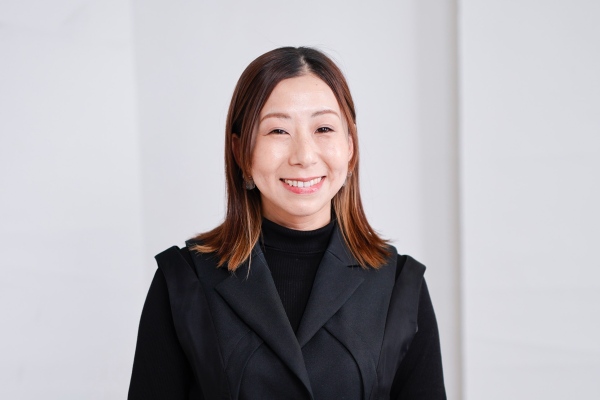
Karin Noda
1. Congratulations on winning the London Design Awards! Can you introduce yourself and share about what inspired you to pursue design as a career?
I oversee branding and design for Re:ADY B, a Hiroshima-based upcycling brand that transforms vintage kimono and obi fabrics into contemporary accessories.
Looking back, making things has always been part of my life - drawing, sewing, studying design at art college, then running a gallery and organising arts festivals. I also worked as a writer and event producer. But it was becoming a mother that became my real turning point. A single life event stripped away everything I had built. That fear of losing one's identity so completely pushed me to start again - this time, with Re:ADY B.
2. What does being recognised in the London Design Awards mean to you?
What moved me most was that the jury recognised not just the product itself, but the process behind it. The MIKOSHI Bag is born from the intersection of three distinct crafts: upcycled obi fabric, the metalwork tradition of Hiroshima Buddhist altar making, and the careful handwork of artisans at a labour support facility.
To have that vision - where social impact and design excellence are not in conflict but inseparable - recognised on a global stage gave us real confidence in what we are building.
3. How has this achievement impacted your career, team, or agency, and what opportunities has it brought so far?
The biggest shift was in our team's confidence. Every core member of our team is a working parent, each balancing their own life. Together with labour support facility members and traditional craftspeople, we make things that we now know can stand on a world stage - and that means more than any sales figure.
I have always believed that design should not be used as a tool to solve social problems, but rather that genuinely good design, pursued honestly, naturally creates social value as a result. This award felt like proof that the world agrees.
4. What role does experimentation play in your creative process? Can you share an example?
Since no two pieces of our material are ever the same, the making process is itself a continuous experiment.
With the MIKOSHI Bag, one principle guided every decision: cut the obi as little as possible. Rather than designing a bag and fitting the fabric to it, we asked how to best honour what was already there. Obi are traditionally designed so that their finest pattern appears through the otaiko knot - a classic Japanese draping style. We structured the bag's front panel to show a surface area close to what that knot reveals, so the fabric's original beauty is preserved rather than reinvented.
The same spirit of trust shaped the metalwork. We discussed the overall form of the brass handles together with the craftsman, but the arabesques engraved inside - the karakusa motif - we left entirely to the Hiroshima Buddhist altar metalworker. Centuries of inherited craft carry a beauty I could not design myself. Knowing when to step back and trust the expert is, I believe, part of design.
The leather edging presented another major challenge. The hand-stitching technique we use is borrowed from leathercraft and not normally applied to obi fabric. Joining two such different materials cleanly took more than six months of trial and error.
Our process is less about generating something entirely new than about building a dialogue between Japan's traditional crafts and contemporary design - and letting that conversation lead somewhere neither could reach alone.
5. What's the most unusual source of inspiration you've ever drawn from for a project?
My inspiration rarely comes from a single source. Over the years, I have drawn, made pastries, written books, and organised events - roughly 40,000 hours of creative work across very different fields. What I discovered is that my real strength is not in creating from zero, but in finding the strengths in different people and crafts and designing how they connect.
One unexpected influence was a food factory. Watching how industrial food production achieves consistent quality through meticulous process design - rather than individual skill - was a revelation. I brought that same thinking into our collaboration with labour support facilities, designing workflows so that every artisan can contribute their best, consistently.
6. What’s one thing you wish more people understood about the design process?
For Re:ADY B, design means deciding what to keep and what to let go - within the constraints given by our materials and our collaborators.
No two pieces of vintage obi are the same in weight, weave, or condition. Traditional craft carries centuries of inherited technique, meaning there are things that simply cannot be changed. That might sound limiting. But I find constraints the most interesting part.
The question "what is only possible with this material, this technique?" is what leads us to designs no one else could make. For me, constraints are not obstacles - they are the work itself.
7. How do you navigate the balance between meeting client expectations and staying true to your ideas?
We almost never start with design. We start by listening - to a company's history, its challenges, what it is really trying to solve. Every client, regardless of industry or size, carries something they genuinely want to change.
Our work is to address those needs through the lens of Japanese craft and culture. This means the time spent before we draw anything - understanding what truly needs to be realised is often longer than the making itself. And of course, the result must also be something customers genuinely desire. Meeting those two things at once is when a product becomes truly valuable.
8. What were the challenges you faced while working on your award-winning design, and how did you overcome them?
The hardest part was not deciding who made what, but making four entirely different crafts - upcycled obi, Buddhist altar metalwork, leather edging, and labour support facility sewing - resolve into a single coherent object.
Crucially, all four were developed simultaneously, not sequentially. Each team moved forward trusting that everything would come together at the end. My role was not to design every element myself, but to hold a clear vision of the finished whole and create the conditions for each craft to contribute at its best. The MIKOSHI Bag is the result of that trust.
9. How do you recharge your creativity when you hit a creative block?
I tend to make something before I finish thinking. When I am stuck, I reach for materials rather than more reflection. Actually spreading out an obi, trying a combination, building a prototype - the materials themselves often point the way. I find that thinking alone is limited by what I already know, but working with real materials opens up possibilities I could not have imagined. For me, creativity lives in the dialogue between hands and material, not inside my head.
10. What personal values or experiences do you infuse into your designs?
The idea that runs through everything I do is: giving a new beginning to what has been declared finished.
This is not only about obi and kimono. When I became a mother and lost all the work I had built, I felt I could never return to who I had been. But looking back, nothing was truly lost; it had simply changed form. Every skill, every experience had quietly become part of what Re:ADY B is today.
I believe the same is true of materials, of craft traditions, of people. Nothing is truly spent. The question is always: how do we reframe its value and give it a new role? If our work can offer someone the feeling that they too can begin again, that is the deepest thing we hope to achieve.
11. What is an advice that you would you give to aspiring designers aiming for success?
Keep asking: what can only I do?
Skills can be learned, but skills alone will eventually be matched. I asked myself many times whether there was any point in my remaking kimono if it was simply remaking. The answer came from pushing the question further. I realised my role was in connecting people and crafts and designing something new from that combination.
Your life, your place, your failures, the people you have met, all of it builds a perspective that belongs only to you. Even what looks like a detour is becoming your own irreplaceable strength. Trust your life as your material.
12. If you could collaborate with any designer, past or present, who would it be and why?
Issey Miyake.
In my twenties, I saw an ISSEY MIYAKE collection presented at the Louvre in Paris. The experience has never left me. It was not simply fashion — the entire space was the design. And standing there, I saw Japanese aesthetic sensibility commanding the world's most prestigious stage. I thought: one day, I want to be on that side.
Although we can no longer meet, his approach - deep respect for Japanese structure and thought, expressed in a language the whole world can receive — remains a guiding ideal for me. I hope to do the same, in our own way, with the traditions of Japan.
13. What's one question you wish people would ask you about your work, and what's your answer?
"What does design mean to you?"
For me, design is the act of building a system in which people, crafts, and materials support one another to create new value, drawing on the era I live in, the place I live in, the people I have met, and the traditions passed down to us.
A single product is not the end. Through that product, a master craftsperson finds work, artisans at a labour support facility contribute their skill, and a local tradition is seen with fresh eyes. Designing that cycle - that ecosystem - is what Re:ADY B means by design.
And always: the product must first be beautiful, desirable, worth having. The positive cycle follows from that. Ultimately, we believe that kind of work moves us toward a world where everyone can find meaning in what they do.