
2026
Rehab Explorer: Dynamic Adaptive Rehabilitation Walker
Entrant
International School of Design, Dongguan University of Technology
Category
Product Design - Healthcare
Client's Name
-
Country / Region
China
Gallery
About The Entry
[ Background & Problem ]
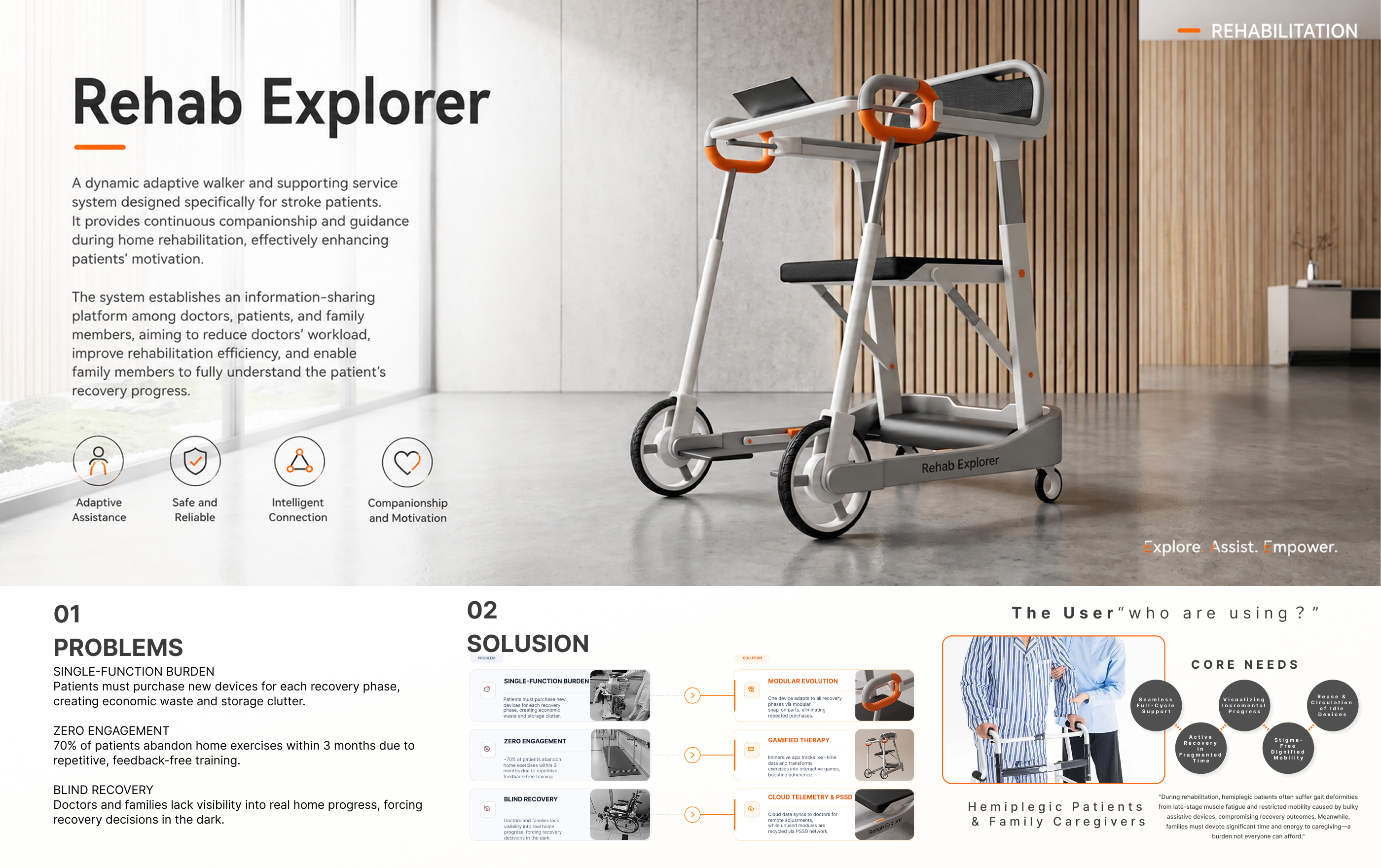
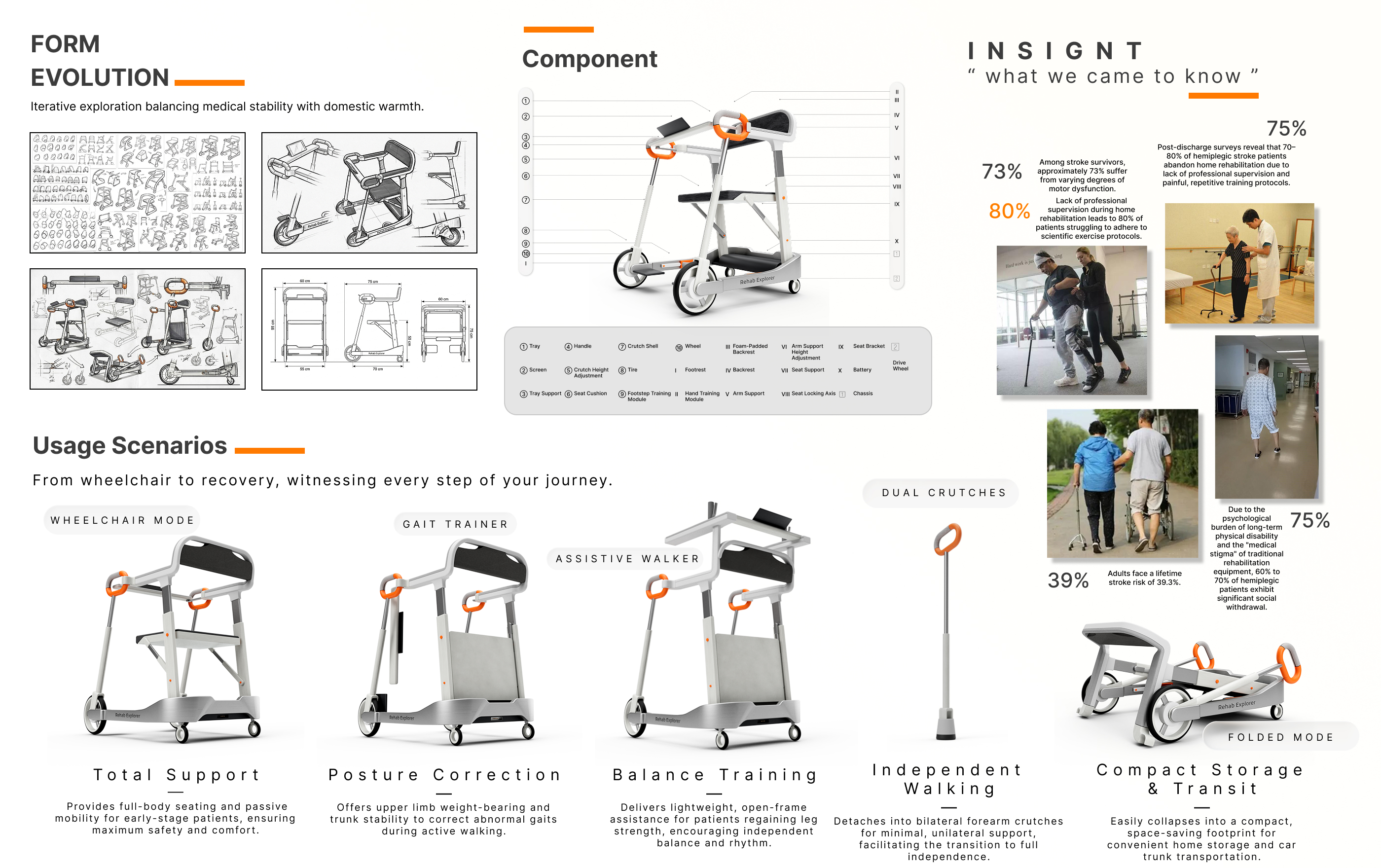
Stroke rehabilitation is a lengthy, dynamic process, yet traditional assistive devices remain functionally rigid. Patients are forced to frequently purchase new equipment—transitioning from wheelchairs to walkers, and eventually to crutches—as their mobility improves. This linear consumption model leads to severe spatial clutter, economic burden, and environmental waste. Furthermore, home-based recovery is notoriously monotonous and lacks immediate feedback, resulting in high abandonment rates and creating "information silos" among patients, families, and doctors.
[ Core Innovation & Hardware ]
To break this dilemma, this project introduces a comprehensive Product-Service System (PSSD) centered around a dynamically adaptive walker. The physical hardware features an innovative 3-in-1 modular architecture. Through a quick-release mechanism, the device seamlessly evolves alongside the patient's recovery trajectory: transforming from a total-support Wheelchair (for the early flaccid stage) to a posture-correcting Gait Trainer (for the spastic stage), and finally detaching into independent Dual Crutches (for the recovery stage). This "dynamic adaptation" ensures one device serves the entire rehabilitation lifecycle.
[ Software & Gamified Intervention ]
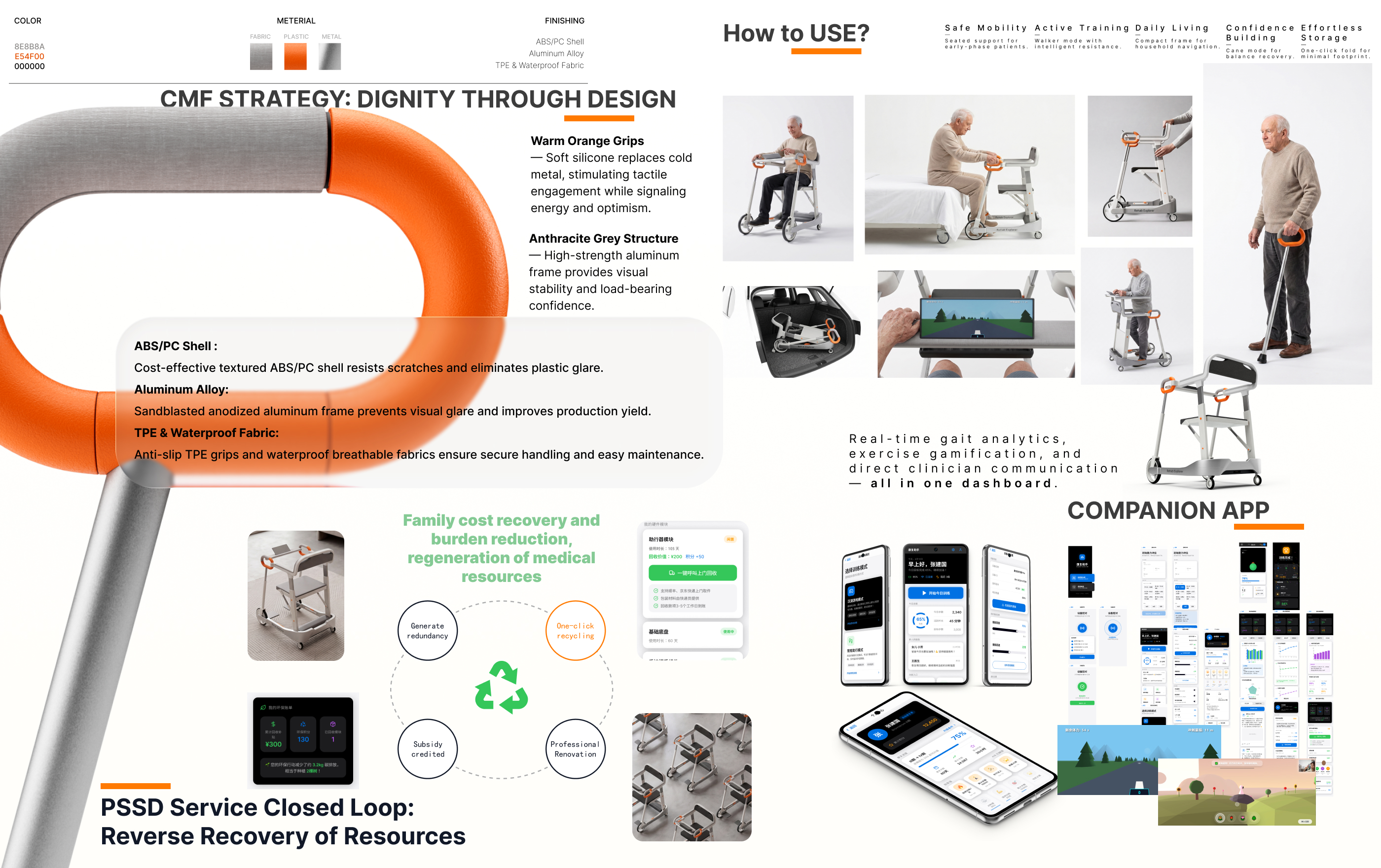
Digitally, the hardware is synchronized with a dual-interface application driven by the Fogg Behavior Model (FBM). For patients, the app translates repetitive physical exercises into engaging, gamified visual achievements (e.g., watering virtual plants through movement) and fosters an accessible peer-support community to alleviate emotional isolation. For caregivers and doctors, it serves as a digital guardian, providing real-time telemetry, fall-prevention alerts, and quantitative gait analysis to enable precise remote guidance.
[ Sustainable Service Ecosystem ]
Crucially, the design pioneers a sustainable reverse-logistics ecosystem. As patients progress and shed redundant hardware modules (such as the heavy wheelchair base), families can initiate a one-click recycling request via the app. These modules are professionally sanitized by partner medical institutions and redistributed to new patients at a lower cost.
[ Value Proposition ]
Ultimately, this project transcends traditional medical equipment design. By integrating adaptable hardware, empathetic digital gamification, and a circular economy model, it restores dignity to stroke survivors, drastically reduces financial burdens on families, and provides a highly scalable, sustainable solution for the global aging society.
Credits


Entrant
Ming Chuan University
Category
Packaging Design - B2B Packaging